

At the heart of this challenge are contact centre agents, who play a critical role in embodying and delivering the brand’s promise through every customer interaction they manage.
This whitepaper examines the significance of agent behaviours on driving customer experiences based on an analysis of over 12,300 contact centre interactions across more than 200 organisations evaluated by CSBA using the SenseCX framework (see Page 13 for details).
Our findings reveal that while certain foundational behaviours establish a solid baseline for service quality, it is a more limited range of signature behaviours that truly distinguish high-performing agents and elevate customer experiences from ordinary to exceptional.
Within this paper, you’ll discover the advanced skills contact centre agents can deploy to create outstanding experiences. By prioritising signature behaviours, your organisation can transform routine agent-customer interactions into valuable opportunities for brand-building.

Studies certainly underscore this with a recent Salesforce* survey revealing
recommend businesses based on excellent service, while
base their purchasing decisions on service quality alone
Given what’s at stake, it’s essential to closely monitor and manage frontline customer service. Traditional approaches to evaluating agent’s performance often rely on Voice of Customer (VoC) feedback, which can lack the detailed insights needed to guide performance improvements.
Customers frequently mention factors beyond the agent’s control, such as fees, product features, or past experiences, when providing feedback, leaving a gap in actionable insights specific to the agent’s performance.
This makes it challenging to effectively guide improvement efforts.
Similarly, while Quality Assurance (QA) monitoring is important, many organisations focus too much on compliance with company standards and regulation, rather than how agent’s behaviours contribute to positive customer experiences and successful outcomes.
What’s more, QA programs are often conducted infrequently and inconsistently, with poorly trained assessors using outdated methods to collect and report on evaluations.
Collectively, these limitations create gaps in understanding what really drives exceptional service.
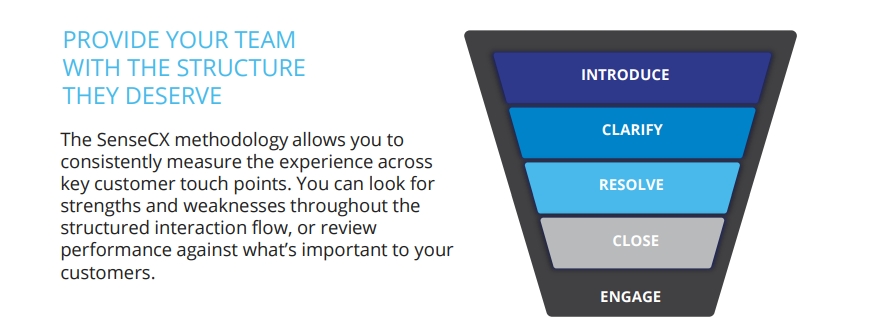
The SenseCX service experience measurement framework consists of
31 agent behaviours
12,300 analysed contact centre interactions
Our evaluation of more than 200 organisations was subjected to a statistical technique called Principal Component Analysis (PCA) to identify the following key behaviours.

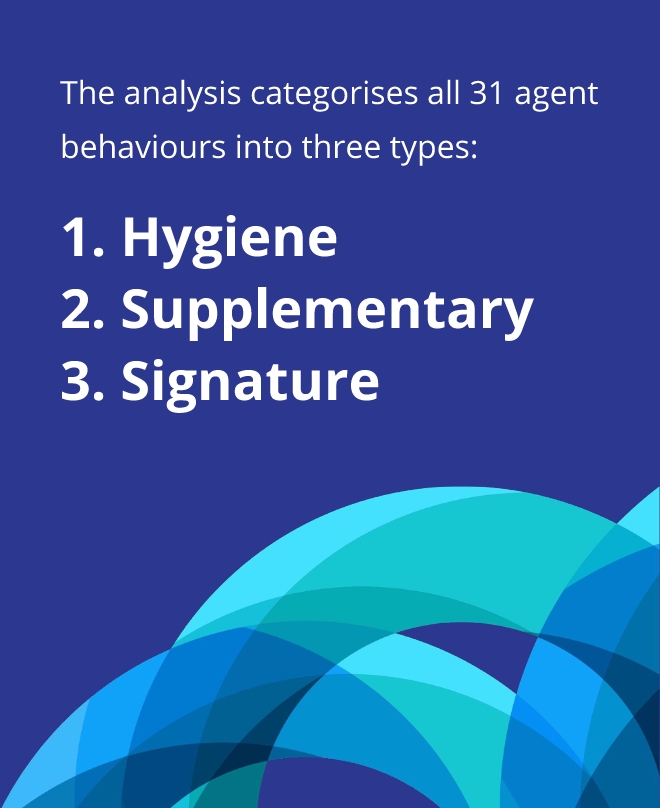
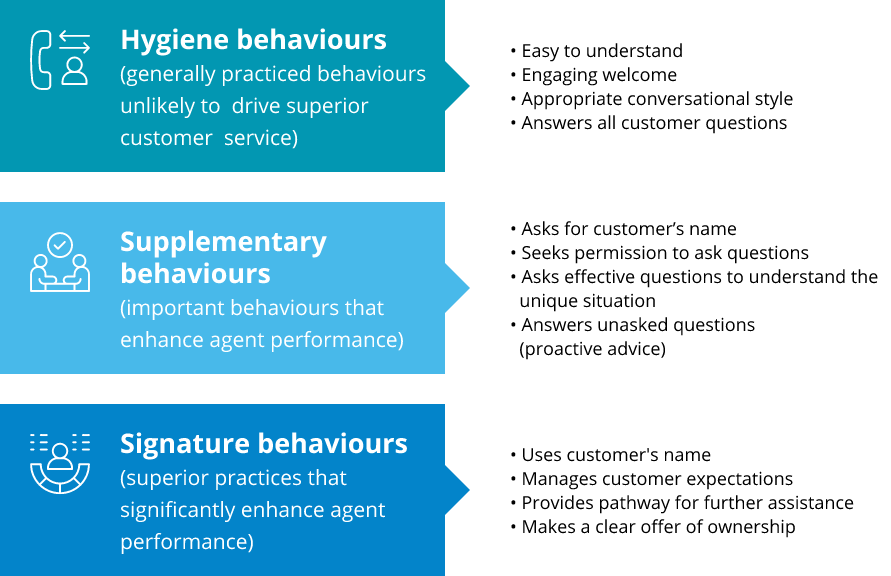
While hygiene behaviours are important for maintaining a basic level of service quality, and supplementary behaviours enhance interactions, it’s the signature behaviours that set exceptional customer service apart. Agents who excel in these signature behaviours don’t just meet expectations –they become true brand ambassadors, shaping positive customer perceptions and building lasting connections.
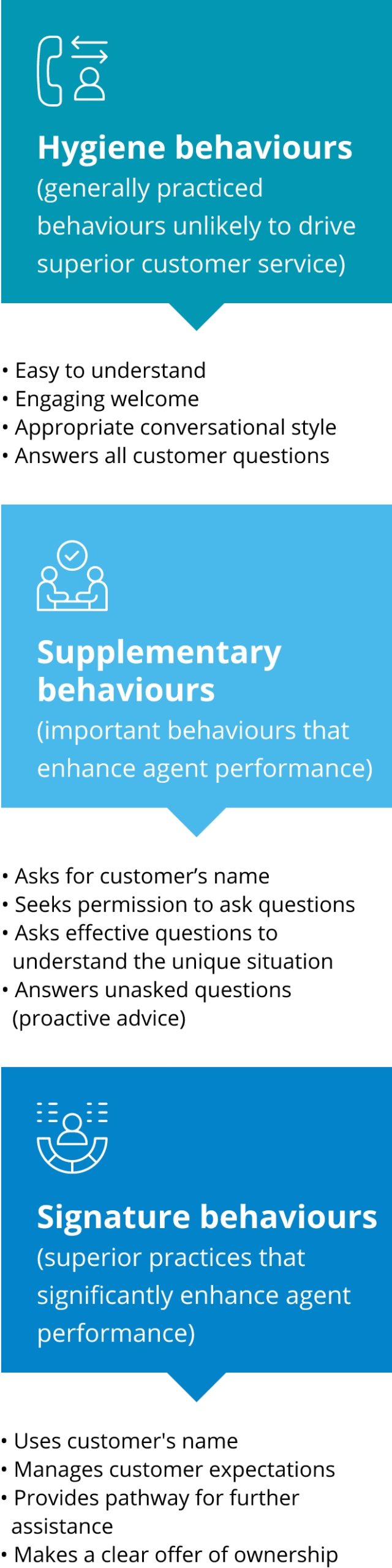
Hygiene behaviours form the foundation of effective customer service. These are skills that agents typically master easily, and while essential for delivering basic service, they don’t create a lasting impression on the customer experience.
Supplementary behavior son the other hand, play a greater impact in distinguishing great service, but they are more challenging to execute consistently. When these behaviours aren’t regularly demonstrated by agents, improving customer satisfaction becomes more challenging.
At the opposite end of the spectrum are signature behaviours which require more advanced skills. Though harder to master, they have the potential to significantly elevate the customer experience, setting exceptional service apart from the rest.

Consistently demonstrating these agent behaviours is essential for maintaining high-quality customer service. While getting the basics right is expected, organisations must go further by focusing on Supplementary and Signature behaviours to truly elevate the customer experience.


This basic behaviours, which conveys courtesy and respect, is overlooked by most agents we evaluated. This may, at least in part, be due to concerns about sounding too formal or scripted, wanting to avoid cultural blunders, time constraints or simply inadequate training and supervision. However, our analysis heavily underscores the importance of using customer’s names to drive great customer experiences. Agents can be assisted to build confidence in using customers’ names through training, feedback and recognition.

While agents may not be able to always meet customer expectations, they need to effectively manage them to prevent callbacks, complaints and even defection. Our analysis reveals a significant gap, with fewer than half of agents failing to appropriately set expectations for customers. Effectively managing expectations demands agents give their full attention and confirm their understanding of issues. They must then proactively communicate the steps and timelines required to resolve a customer’s enquiry, addressing uncertainties directly and explaining reasons when a clear timeline is unavailable.

Taking ownership means agents take full responsibility for resolving a customer’s enquiry or issue. However, many agents fail to clearly communicate this commitment, missing a vital opportunity to instill confidence. A simple statement like, “I’ll help you with that right now,” not only reassures customers but strengthens their trust in the organisation. Agents must be confident and explicit in their approach, using action-focused language such as “help,” “assist,” “address,” or “resolve,” paired with expressions of immediacy like “now,” “straight away,” or “immediately.”

Agents must fully address customers’ needs during an interaction and make sure customers feel comfortable seeking further advice or asking additional questions before the contact ends. Providing a pathway for further assistance builds trust and confidence in the agent’s abilities while reducing unnecessary re-contact. Agents should offer further assistance or clearly indicate that customers are welcome to ask more questions, ensuring their tone is patient and welcoming.

By focusing on these targeted actions, organisations can effectively improve the quality of their customer interactions, leading to higher satisfaction and improved overall outcomes.

Personalisation Enhances Engagement
One of the key findings is the power of personalisation. Agents who use customers’ names during interactions are more likely to exhibit other desirable behaviours. This practice not only helps in gathering more relevant information that can help agents tailor responses and solutions, it also makes the customer feel valued.
Proactive Communication Improves Service Quality
The use of “temperature checks” during calls, when agents gauge the customer’s understanding and acceptance of solutions or advice, significantly impacts service quality. Our analysis shows that agents who employ temperature checks are over three times more likely to address unasked questions. This proactive approach ensures all customer concerns are anticipated and resolved.

To effectively integrate signature behaviours into your customer service strategy, a comprehensive approach that blends targeted training with ongoing performance monitoring is essential. Implementing the following strategies will help enhance agent skills, ensure alignment with service goals, and drive exceptional customer experiences:
1. Establish Clear Performance Benchmarks: Set clear performance benchmarks for each signature behaviour and track progress using detailed metrics. Incorporate these benchmarks into your quality assurance framework to monitor how effectively agents are applying these behaviours. Regularly review these metrics to identify trends and areas for improvement.
2. Embed Signature Behaviours in QA Processes: Update your quality assurance processes to include evaluations of signature behaviours. Develop a detailed assessment framework that focuses on how well agents implement these advanced practices during customer interactions. Ensure that QA evaluators are trained to recognise and assess these key behaviours accurately.
3. Align VoC Metrics with Signature Behaviours: Ensure that VoC feedback surveys and metrics are designed to capture insights related to signature behaviours. For instance, include questions that assess customers’ perceptions of personalisation, expectation management, and effective questioning to get to the heart of the customer’s enquiry. This alignment will help in identifying specific areas where agents excel or need improvement.
4. Implement Regular Feedback and Support: Create a system for ongoing feedback that provides agents with specific, actionable insights into their performance. Offer regular coaching sessions focused on reinforcing signature behaviours and provide agents with the tools and resources they need to improve. Foster an environment where feedback is seen as a constructive part of their development.
5. Design Comprehensive Training Programs: Develop training programs that are specifically tailored to signature behaviours. Incorporate interactive elements like role-playing and simulations to allow agents to practice these advanced skills in realistic scenarios.
6. Leverage Peer-to-Peer Learning: Promote knowledge sharing by organising workshops or mentoring programs where experienced agents can share their expertise in signature behaviours with their peers. Encourage collaboration and learning from each other’s experiences to build a culture of continuous improvement.
7. Adjust Based on Insights: Regularly analyse feedback from customers and performance data to adjust training and QA strategies. Use these insights to refine your programs, address any emerging gaps, and ensure that the focus remains on behaviours that drive exceptional customer experiences.

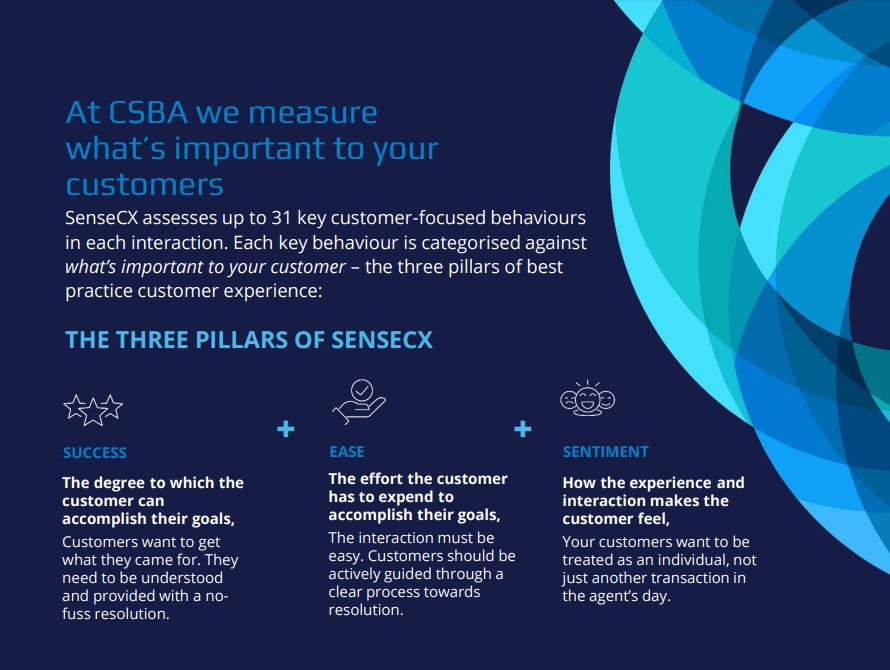
Up to 31 customer-focused key behaviours help your team to:
• Collaborate with their customers, ask the right questions to make the conversation easy for everyone.
• Listen carefully and respond effectively to customer cues.
• Personalise interactions with their customers, to enhance both customer loyalty and staff engagement.